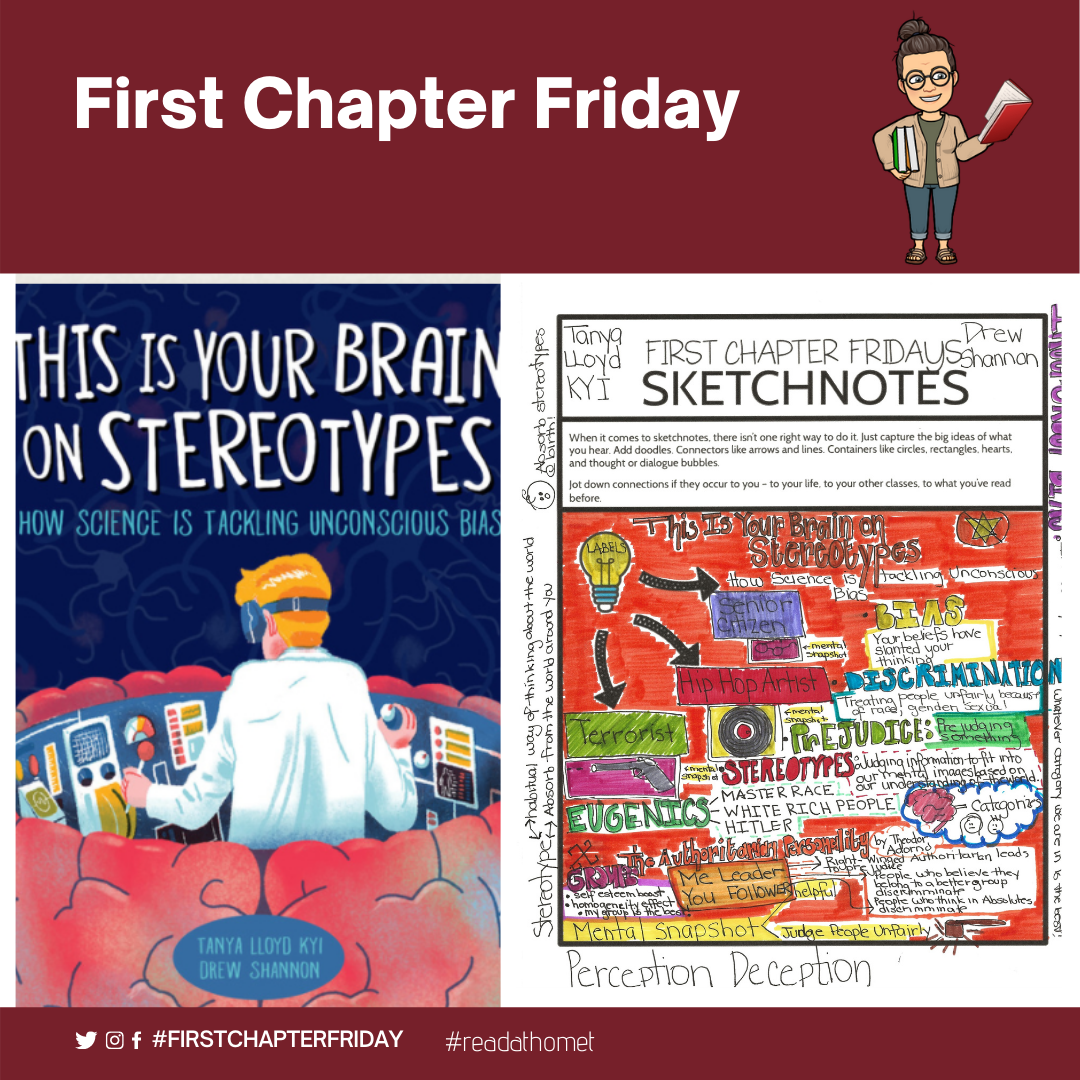
First Chapter Friday: This is your Brain on Stereotypes


 First Chapter Friday
Today is First Chapter Friday and the book is :
This is Your Brain on Stereotypes: How Science is Tackling Unconscious Bias  by Tanya Lloyd Kyi & Drew Shannon. There was so much interesting information just in the first chapter about bias, discrimination, prejudice, and stereotypes. It gives a brief history of eugenics - the idea that Caucasian people are the master race, and who led those ideas. I thought the information on baby bias was really interesting: that babies that are surrounded by various people of color showed no preference. I am looking forward to reading the rest of this book.

Comments

Popular posts from this blog

Book Trailer Tuesday

  It is Book Trailer Tuesday and today’s book trailer is called Kingston and the Magician’s Lost and Found  by Rucker Moses and Theo Gangi. Kingston and the Magician's Lost and Found  is about Kingston’s father who disappears through a magic mirror and does not return.  The family moves into his father’s old home in Brooklyn, and Kingston begins to see visions of his father.  The book was just released last week, so it has not yet made it to Sora - but soon will.  Still, watch the trailer or listen to the audio excerpt!

Disruptive Thinking

Disruptive Thinking      Chapter 13 of Disruptive Thinking is all about focused silent reading.  Malcolm Gladwell in his book Outliers  discusses the idea of 10,000 hours of deliberate practice to become an expert.  Ten thousand hours adds up to approximately 10 years.        We know that students who read for fun is on the decline.  As educators, we know that reading improves academic achievement, builds background knowledge and helps develop empathy and personal  identity.  All these things contribute to future employment and standard of living.  If students are not practicing reading on a daily basis, how can they ever be an expert? Students in the 30th percentile are reading approximately 1.8 minutes a day, being exposed to only 106, 000 words in a year.  Asking kids to read  just an extra 10 minutes a day would expose them to 556% more words. To be a reader, you must read.      ...

Disruptive Thinking

Disruptive Thinking  Disruptive Thinking, chapter 14, addresses reading the same book.  After reading study after study for an action research project regarding Accelerated Reader, all confirmed that students want free choice regarding book choice.  Beers and Probst also argue this - free choice means free choice!  Free choice leads to finishing a book, which could lead to that book becoming a students favorite book.  Free choice isn't reading levels.  However, teacher guidance must occur while students are silent reading..  They give an example of a student reading a book beyond her comprehension.  They asked the student if she liked the book, and she said "No".  They advised that if the student insisted on reading the book, they would advise her to listen to the audiobook while reading the book.     They go on to suggest to listen to an audio book as a class while students to follow along with the text..  However, t...